

‘Maximum Pleasure Guaranteed’ Surprises Fairly
Sometimes you can judge the writing of an entire show by one scene.
NEW STANDARD DISCLAIMER: This newsletter aggressively spoils things.
It’s hard, sometimes, to tell the difference between my brain’s general decay producing hallucinations and genuine pattern recognition1. I often joke to my wife, The Duchess, that everyone opening a business in our little town went to the same entrepreneurial franchising convention, for example, because similar businesses will suddenly pop up selling us the same basic things, like poke bowls or gelato2. Or, sometimes, films with weirdly similar premises will be released, and you have to wonder if the screenwriters were climbing the same mountain of cocaine at the same party when they had that concept, or if studios hear rumors and just rush competing scripts into production.
Or, maybe, I’m much older than I think I am and everyone is thinking aw, look at Jeff, he’s so adorable when he’s confused! Someone find his pants, for god’s sake3.
I think about this because The Duchess and I started watching Maximum Pleasure Guaranteed, which is just one of a billion pretty good! streaming series out there these days. I grew up during a period of awful television, so I am still sometimes stunned at how good we have it now4. Sure, streaming sucks in some ways and I am paying way too much for content I don’t want, but on the other hand the days when people actually watched shit like The Dukes of Hazzard are long gone, and amen5.
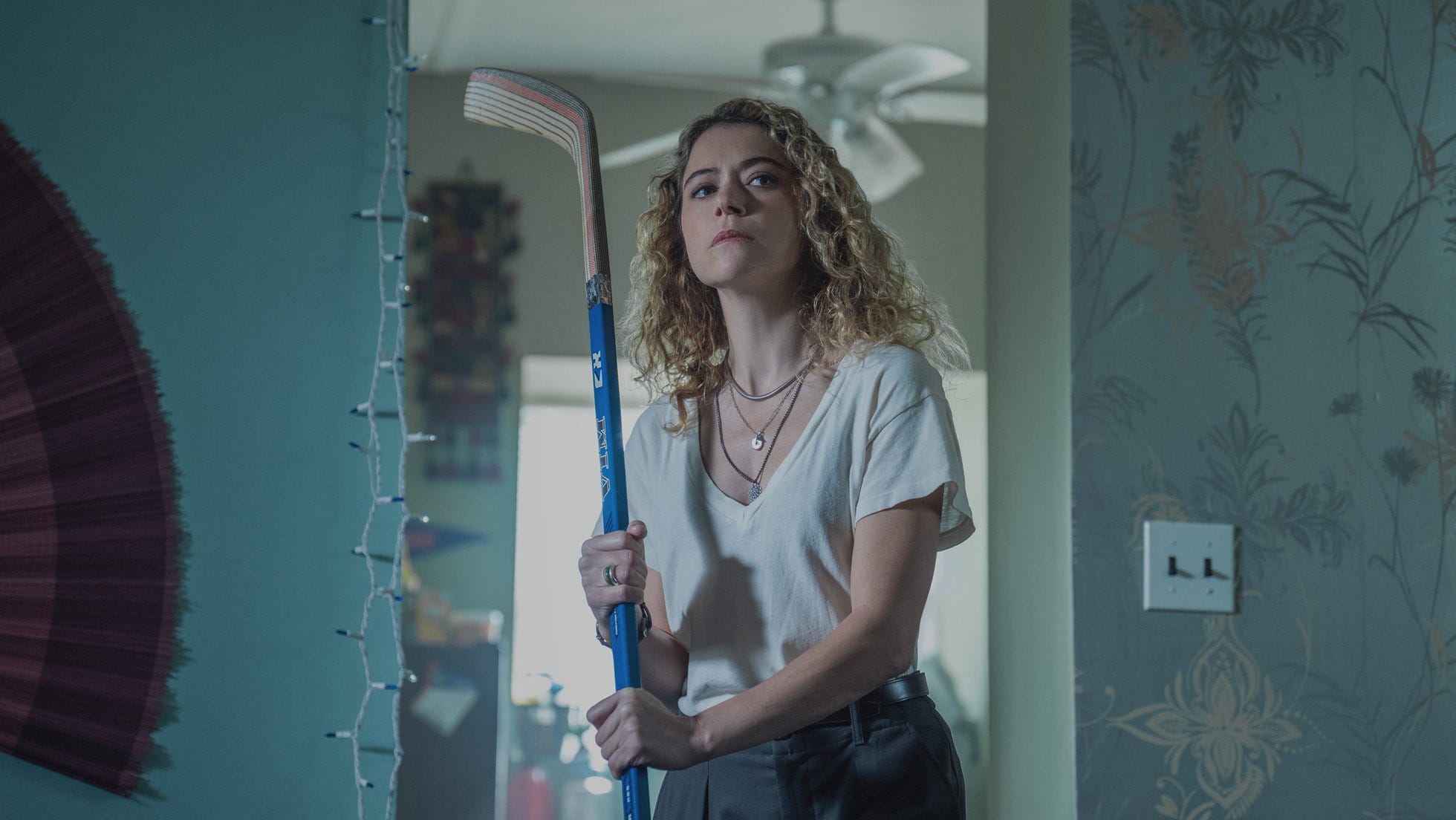
Maximum Pleasure is a fun series about a struggling fact-checker, Paula (Tatiana Maslany), who’s in the midst of a messy divorce and stuck in a professional rut. Lonely and a bit depressed, she’s been going on virtual dates with a camboy named Trevor (Brandon Flynn), during which she talks way too much about her personal life6. Trevor stages a kidnapping and then tries to scam Paula for ransom money, but when she tracks him down to his house to defend herself she finds him very, very dead—and is targeted by Trevor’s handler-slash-lover, Dennis (the always delightful Murray Bartlett).
That’s a solid setup, and the series is well done. It’s particularly good about keeping the B and C plots connected to the main story, but it’s also just written, directed, and edited with a sturdy approach to craft that I appreciate7. Sometimes you can watch one scene of a show and know that it’s been made with care by professionals, and that’s Maximum Pleasure Guaranteed. For example, let’s look at the surprise at the end of episode six, “Rosebuds.”
Scene Missing
As Paula realizes she and her daughter are in serious trouble, she purchases a gun at the end of episode five8. In episode six, we see her bring the gun home and conscientiously lock it up in a safe in her bedroom—she’s got partial custody of a young daughter, after all, and she’s about to host a make-you-own-pizza party for the school soccer team she coaches. Locking the gun up makes a lot of sense.
It also makes her vulnerable. Dennis is shown stalking her—breaking into her apartment, murdering the private detective her estranged soon-to-be ex-husband hired, and generally being a sociopathic asshole—and there are ominous signs that he’s planned something very nasty for Paula. She senses this, too, so when she takes a walk at night to the local bodega, it’s one of those yell at the screen moments. As she walks, she tries to be situationally aware, to be vigilant. But then, it happens: As she approaches a dark area shielded by some overgrown trees, the trunk of a parked car pops open. As she’s distracted, Dennis emerges and, after a brief struggle, he forces her into the trunk and drives away9.
It’s a not-unexpected moment, really; Paula is out of her depth and Dennis has already shown himself to be a solid planner and a ruthless killer. We figure Paula won’t die here, because she’s the protagonist, but we won’t know how she’ll escape. What happens is, Dennis drives to an isolated spot, walks to the rear of the car, pops the trunk—and Paula shoots him. With the gun we totally forgot she had10.
The trick is simple: We’re shown Paula deciding to go to the bodega. Then we see her on the street. We’re not shown that she goes back to her apartment, so as far as our poor monkey brains are concerned that gun is still locked up in the last place we saw it, in the safe in her bedroom11. This bit of misdirection works a charm.
I Don’t Want That for You
Writers rely on a lot of trickery to surprise you or misdirect you, and this particular bit of sleight-of-hand is well done. What we’re shown—Paula hiding the gun away—is done very naturalistically, so it doesn’t jab at us as something to make note of. But it does imply that the gun is now inaccessible and that getting the gun will be a problem, later12. When she puts it in the safe, the audience thinks, well, that won’t help her when Dennis shows up, because she’ll have to race to her room and fiddle with the safe. We’ve been shown that Dennis can and has entered the apartment, so that’s what we expect.
When Paula leaves, we assume not seeing her grab her coat and handbag for the trip to the store was simply efficient editing—we don’t need to see that. So it doesn’t occur to us that what we weren’t shown included Paula retrieving the gun. But when she produces and uses the gun, it’s not a cheat: We knew she had it, and she had plenty of opportunity to get it.
Is this brilliance? No! But it is simple competence in writing, and that is not always guaranteed13. It’s a simple trick that works very, very well.
Don’t I have anything better to do than micro-analyze a single scene from a semi-obscure TV show? That’s the real trick, here: No, I absolutely don’t.
NEXT WEEK: Love Actually is a Study in Passivity
If you enjoy this newsletter, consider subscribing to my paid fiction Substack, Writing Without Rules: From the Notebook!
For example, is the fact that I haven’t worn a matching pair of socks in 12 years a problem or a sign of genius?
When I was a youth, we had to choose between pizza and nothing every day, and all the pizza places were fronts for the mob where no one knew how to actually make pizza, and we liked it! Actually, the past sucked, forget I said anything.
Joke’s on them: I haven’t owned a pair of pants since 1997.
Exhibit A through infinity: Shields and Yarnell was a big hit show when I was young. I still wake up screaming.
I was too young for Daisy Duke. I was into The Dukes of Hazzard for love of the game.
This I don’t understand. I don’t even tell people my real name.
Yet rarely employ in my own writing. My process is more or less Lost Weekend: I wake up every Monday in a new jail and search my pockets for manuscript pages. Works every time.
This is a rare show that actually takes a beat to show Paula learning how to shoot, which I applaud. Though how characters on TV have enough time to do all the things they do remains a mystery.
The Duchess is fond of informing me what she would do in these situations in a tone of confidence, forgetting that I have seen her melt under even the mildest stress.
Well, I forgot about it. But I also just forgot why I’m writing this footnote, so it’s obviously not a challenge to bamboozle me.
Apologies to the Lizard People and They Live aliens who are reading this.
Life goal is to someday possess something worth putting in a safe. Apparently the 10,000 baseball cards I collected as a kid are not that thing.
See: Much of my own work.
Well, that was a damn pleasure to read - your footnoting is A+, sir! I do remember Shields and Yarnell (why????) and I watched Dukes of Hazard and had a crush on Tom Wopat. I've never heard of this show, but I agree with the writing - you can tell SO much about a show from little things like that misdirection.
😆. Jeebus, I actually clicked on the Shields and Yarnell link. Don't do that!